◆ Checklist · engineer-reviewed
Before you build: the land evaluation checklist
बनाउनुअघि: जग्गा मूल्याङ्कन चेकलिस्ट
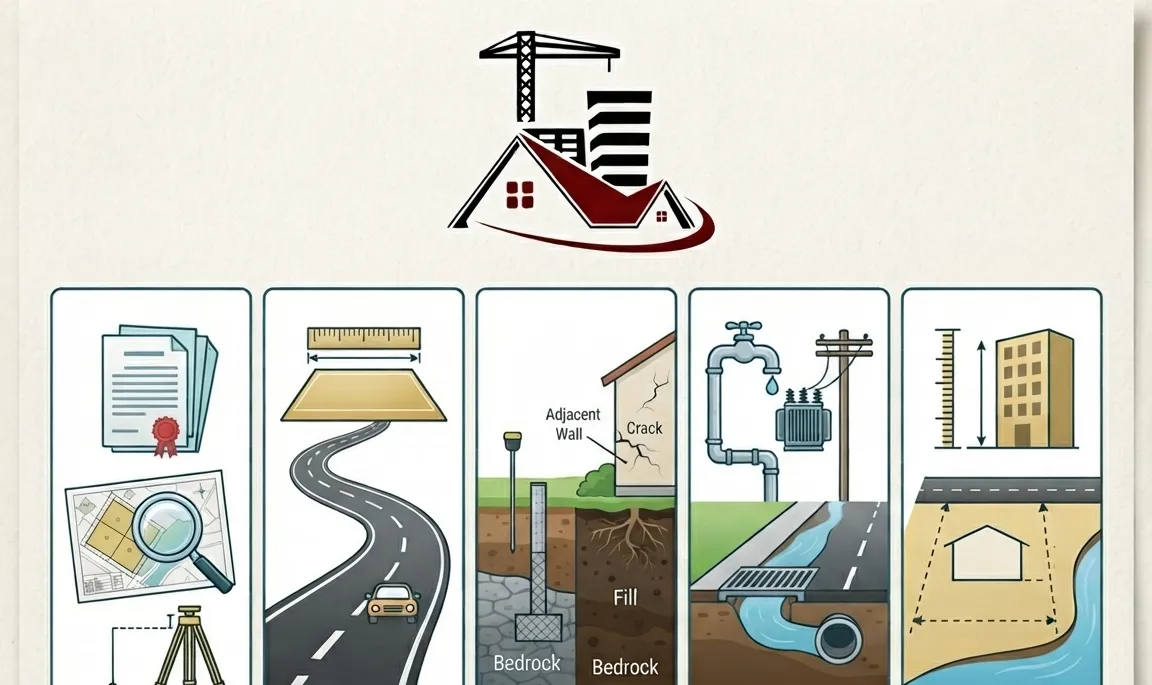
Most expensive mistakes in a house build happen before construction starts — at the moment the land is chosen. This is the checklist our engineers run on a plot before we agree to design on it.
1. Papers first: ownership and boundaries
Ask for the Lalpurja (land ownership certificate) and match it against the trace map / blueprint from the Survey Office. What we verify:
- The seller's name on the Lalpurja matches the citizenship certificate.
- The plot number (कित्ता नं.) and area on paper match the trace map.
- No pending mortgage, court case, or rokka on the plot — a check at the Land Revenue Office (मालपोत) takes half a day and saves years.
- Boundaries on the ground match the map. We measure; we never assume the fence is the boundary.
2. Legal access to the plot
A plot without a registered access road (bato) can be nearly impossible to get a building permit for. Confirm the access shown in the trace map physically exists and its width meets the local municipality's minimum — commonly 4 m or wider for a permit in Kathmandu Valley municipalities, and more if you ever want to go tall.
3. Ground you can trust
Rice-field fill, old pond beds and river-edge plots behave very differently under a two-storey load. Signals we look for on site:
- Standing water or unusually soft ground after dry weeks.
- Cracks in neighbouring buildings and boundary walls.
- Fill depth — recent fill needs time or engineering (compaction, deeper foundations).
For anything ambiguous we recommend a soil test before design. It costs a fraction of one percent of the build and decides the foundation type honestly.
4. Services: water, power, drainage
Check the practical distance to the nearest water line, transformer and — most forgotten — where the plot drains. A plot lower than the road will pump sewage uphill for the life of the house.
5. Setbacks and what you can actually build
Every municipality enforces setbacks from the road centreline, river banks and high-tension lines, plus a Floor Area Ratio (FAR) and height limit. A 4-aana plot does not mean 4 aana of ground coverage. We run the numbers before purchase so the house you imagine is the house the rules allow.
Bringing a plot to Treta before you buy it is a service we genuinely enjoy — a one-visit review is cheap insurance. Start a conversation.